
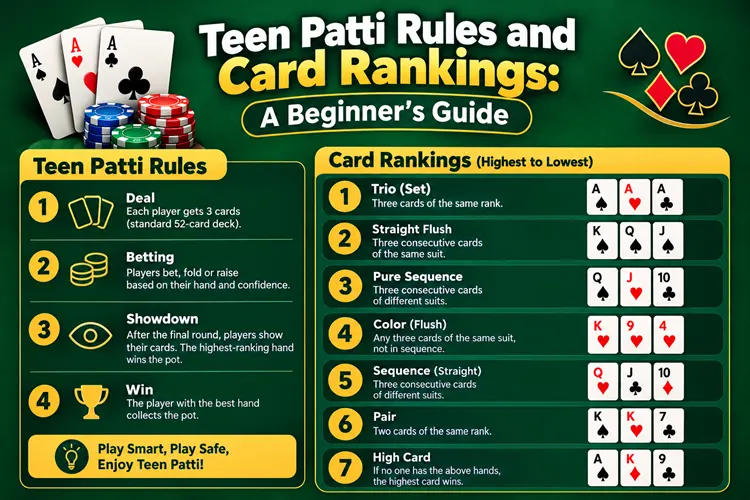
Teen Patti Rules and Card Rankings: A Beginner’s Guide
Teen Patti is India’s favourite three-card game: easy to learn in ten minutes, and just tricky enough to keep a table talking all night.
How a round works
Teen Patti (literally “three cards”) is played with a standard 52-card deck, no jokers, by anywhere from 3 to 6 players. Aces can be high or low, and suits carry no ranking of their own.
Before any card is dealt, every player puts a fixed amount into the middle. This is called the boot (or ante), and it creates the first pot, so there is always something to win. The dealer then gives each player three cards, one at a time, face down.
From there, players take turns, moving clockwise from the dealer’s left. Each turn you either stay in the hand by betting, or fold and walk away. The round ends when only one player is left, or when two players remain and one asks for a show, where both reveal their cards and the better hand takes the pot.
That is genuinely it. Everything else in the game is about reading people and knowing when to push.
Card rankings, best to worst
There are only six kinds of hand, which is why the game is so quick to pick up. Here they are from strongest to weakest, with the odds of being dealt each one in a single three-card hand.
| Rank | Hand | What it means | Example | Chance |
|---|---|---|---|---|
| 1 | Trail (Set) | Three cards of the same rank | K♠ K♥ K♦ | 0.24% |
| 2 | Pure Sequence (Straight Flush) | Three consecutive cards, all one suit | 9♣ 10♣ J♣ | 0.22% |
| 3 | Sequence (Straight) | Three consecutive cards, mixed suits | 5♠ 6♥ 7♦ | 3.26% |
| 4 | Color (Flush) | Three cards of one suit, not in sequence | 2♥ 8♥ Q♥ | 4.96% |
| 5 | Pair | Two cards of the same rank | 7♠ 7♦ K♣ | 16.94% |
| 6 | High Card | None of the above; highest card wins | A♠ 9♥ 4♦ | 74.39% |
A few things trip up new players:
- Trail beats Pure Sequence. This is the opposite of what poker players expect, and it makes sense once you see the odds: a trail is slightly rarer.
- Sequence beats Color. With only three cards, a sequence (3.26%) turns up less often than a color (4.96%), so the order differs from five-card poker.
- Aces are flexible in sequences. A-K-Q is the highest sequence and A-2-3 is the second highest. 4-3-2 is the lowest. Q-K-2 does not count as a sequence, because the run cannot wrap around.
- The highest trail is A-A-A, and the lowest is 2-2-2. Suits never break a tie between trails.
Breaking ties
When two players hold the same type of hand, the higher cards win. Two pairs are compared by the pair’s rank first, then the third card. Two colors are compared by their highest card, then the next, and so on. If everything matches exactly, suits still do not count, so the pot is split, or in a show the player who did not ask for it wins (house rules vary, so settle this up front).
Betting: blind, seen, and the art of the bluff
This is where Teen Patti gets its personality. Each player is either blind or seen, and the difference shapes everything.
A blind player has not looked at their cards. They can bet the current stake, or double it. A seen player has peeked, and must bet at least double the current stake, and up to four times. Looking at your cards costs you a little flexibility, but it tells you whether you are worth the money.
On your turn you can do one of these:
- Chaal (play): match the stake and stay in.
- Raise: increase the stake. Everyone after you now faces the higher number.
- Pack (fold): give up your hand and your chips already in the pot.
- Show: when only two players remain, pay to reveal both hands. The better hand wins.
- Side show: a seen player can ask the seen player just before them to compare cards privately. The weaker hand must fold. The other player can refuse.
None of these numbers are universal. Stake limits, the number of raises allowed, and whether a side show is permitted all change from table to table and app to app, so confirm the house rules before the first deal. Most arguments in Teen Patti are really arguments about rules nobody mentioned.
Bluffing carries the game. With 74% of hands being just a high card, most players are holding very little most of the time, and a confident raise can end a round before any card is shown.
Popular variations
Once the basics feel natural, the variations are where friends’ groups find their own flavour. These are common ones, though names and exact rules differ by region.
- Muflis (Lowball): the ranking flips, so the weakest hand wins. A hand like 2-3-5 beats a trail of aces.
- Joker: one or more cards are declared wild and can stand in for anything, which makes strong hands far more common.
- AK47: every Ace, King, 4 and 7 is a wild card.
- Best of Four: you are dealt four cards and build your best three-card hand from them.
Before you start a variation, say the wild cards and the ranking order out loud. It takes ten seconds and saves the whole night.
Tips for your first few games
- Learn the ranking table by heart. Most beginner losses come from forgetting that a sequence beats a color, or that a trail beats a pure sequence.
- Fold weak hands without guilt. Three-quarters of hands are a lone high card. Folding is not losing, it is saving chips for the hands that matter.
- Watch how others bet. A player who suddenly raises after months of careful play is telling you something, whether it is true or not.
- Play blind sometimes. It keeps costs low and makes you harder to read.
- Fix the house rules first. Agree on stake limits, side shows and tie-breaks before the cards come out.
- Set a limit you can afford. Teen Patti is a game of chance and skill, and any game with money on the table can run away from you. Decide what you are willing to lose before you sit down, and stop when you reach it. Real-money play is also regulated differently across Indian states, so check what is allowed where you live.
With the six hands memorised and a feel for the betting, you have everything you need to join a table. Deal a few practice rounds with friends for matchsticks or points, and the rest comes quickly.