What Is Teen Patti? A Complete Guide for Beginners
Teen Patti is one of the most popular traditional card games in India. Often played during family gatherings, festivals, parties, and social occasions, the game has also become widely available in digital formats. Its simple rules, quick rounds, and combination of luck and decision-making make it appealing to both beginners and experienced players.
For someone who has never played Teen Patti before, the game may initially seem complicated because of unfamiliar card combinations and betting terms. However, once you understand the basic rules and hand rankings, you can follow a game quite easily.
This beginner-friendly guide explains what Teen Patti is, how it is played, the different card combinations, common terms, and some useful tips for learning the game responsibly.
What Is Teen Patti?
Teen Patti, which literally means “three cards” in Hindi, is a traditional Indian card game generally played with a standard 52-card deck. Each player receives three cards, and the objective is to have the strongest three-card hand or make other players fold before the showdown.
The game is often compared with the British card game Three Card Brag because of similarities in hand rankings and gameplay. However, Teen Patti has developed its own rules, terminology, and variations in India.
A typical game begins with players contributing an initial amount to the pot, commonly known as the boot. Cards are then dealt face down, and players take turns deciding whether to continue, place a bet, or fold.
How Does Teen Patti Work?
Teen Patti is generally played by three or more players, although the exact number can vary depending on the table or platform.
The basic flow is straightforward:
- Players agree on the initial stake or boot amount.
- Each player receives three cards face down.
- Players look at their cards or choose to play blind.
- Betting takes place in turns.
- A player can continue, raise the stake, or fold according to the rules being used.
- When only one player remains, that player wins the pot.
- If multiple players remain until the end, a showdown determines the winner based on hand rankings.
The exact betting rules can differ between traditional and online versions, so beginners should always check the rules of the particular game they are playing.
Understanding Teen Patti Hand Rankings
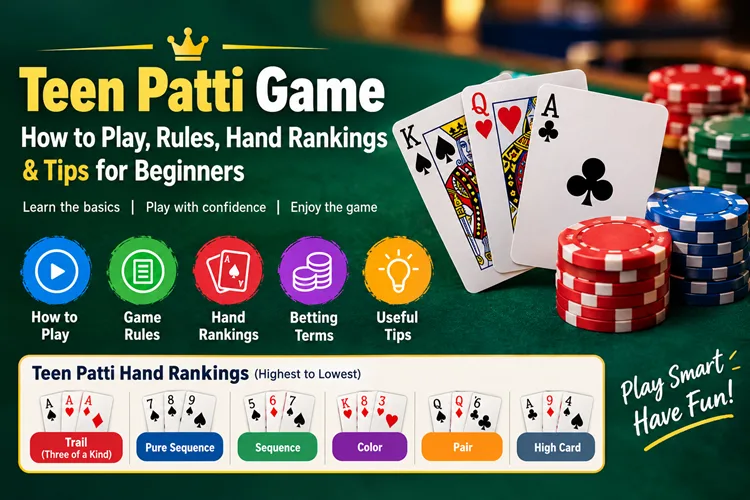
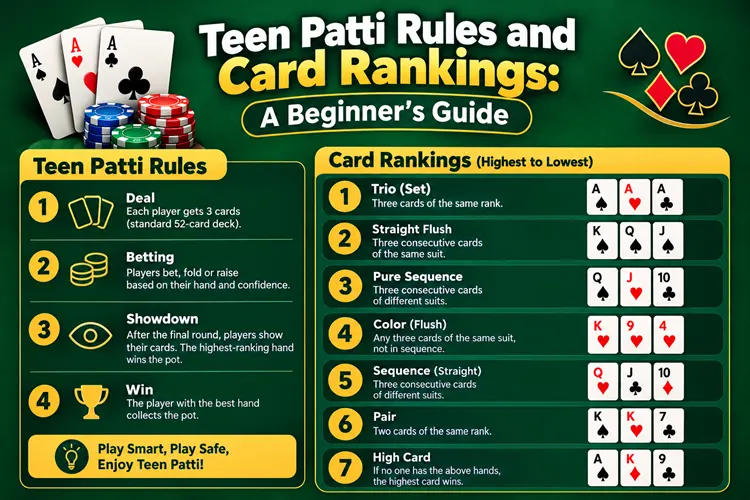
Knowing the hand rankings is one of the most important parts of learning Teen Patti. The stronger your combination, the better your position at a showdown.
1. Trail or Trio
A Trail, also called a Trio or Three of a Kind, consists of three cards of the same rank.
For example:
A-A-A
This is one of the strongest standard Teen Patti combinations. Among trails, the higher-ranked three cards generally beat the lower-ranked three cards.
2. Pure Sequence
A Pure Sequence consists of three consecutive cards of the same suit.
For example:
5♥ – 6♥ – 7♥
Because all three cards belong to the same suit and form a sequence, this is considered a very strong hand.
3. Sequence or Run
A Sequence, sometimes called a Run, consists of three consecutive cards that are not necessarily from the same suit.
For example:
8♠ – 9♥ – 10♣
The cards form a sequence, but they have different suits.
4. Color
A Color means that all three cards belong to the same suit but do not form a sequence.
For example:
2♦ – 7♦ – K♦
The three cards share the same suit, making them a Color.
5. Pair
A Pair contains two cards of the same rank and one different card.
For example:
Q♠ – Q♦ – 4♣
The pair of queens determines the main strength of the hand.
6. High Card
When a hand does not form any of the combinations above, it is generally classified as a High Card hand.
For example:
K♠ – 8♦ – 3♣
The highest card is used to determine its strength against another high-card hand, followed by the next highest cards when necessary.
Blind and Seen Play
One interesting feature of Teen Patti is the option to play blind or seen.
A blind player places bets without looking at their three cards. This can add an extra element of uncertainty to the game because the player does not know the strength of their hand.
A seen player, sometimes called a chaal player, has looked at their cards before making decisions.
The betting requirements for blind and seen players can vary depending on the rules of the table. Beginners should understand these rules before joining a game.
Common Teen Patti Terms
Learning a few common terms can make the game much easier to understand.
Boot: The initial contribution made by players to create the starting pot.
Blind: Playing without looking at your cards.
Seen: Looking at your cards before continuing.
Chaal: A betting action made during the game.
Pack or Fold: Leaving the current round instead of continuing.
Show: Comparing the remaining players’ cards to determine the winner.
Pot: The total amount accumulated through the bets in the current round.
These terms can vary slightly between regions and online platforms, but the basic concepts remain similar.
Why Is Teen Patti So Popular?
Teen Patti has remained popular because it is easy to learn but can offer plenty of strategic decisions. Unlike games with complicated setups, Teen Patti requires only a deck of cards and a group of players.
The social aspect is another major reason for its popularity. It has traditionally been associated with gatherings and celebrations, particularly during festivals and family occasions.
Online Teen Patti has also made the game accessible to people who want to play digitally. Mobile applications and websites can provide different tables, game modes, and variations. However, players should always check local laws and the rules of the platform before participating in any real-money game.
Is Teen Patti a Game of Luck or Skill?
Teen Patti involves both luck and decision-making.
The cards you receive are determined randomly, so no player can control the initial hand. However, decisions made after receiving the cards can influence the outcome. Players may consider their hand strength, betting behavior, the number of remaining players, and the actions of opponents.
That does not mean a good player can guarantee winning. Even experienced players can lose because of unfavorable cards or unexpected outcomes.
This is why Teen Patti should be approached as entertainment rather than as a guaranteed way to make money.
Beginner Tips for Playing Teen Patti
If you are learning Teen Patti, start by focusing on understanding the rules rather than trying to win every round.
Learn the hand rankings first. Knowing which combinations are stronger will help you make better decisions.
Understand the betting rules. Before playing, learn how blind and seen bets work and what the minimum and maximum stakes are.
Start with simple games. Practice with free or low-stakes formats where permitted, so you can become comfortable with the gameplay.
Avoid emotional decisions. Losing one round does not mean you need to immediately increase your stake to recover your loss.
Set a budget. If you play a real-money version where legally permitted, decide beforehand how much you are willing to spend and never exceed that limit.
Know when to stop. Taking breaks is important, especially if the game stops feeling enjoyable.
Teen Patti Variations
There are many variations of Teen Patti. Some introduce special rules involving wild cards, jokers, additional betting conditions, or different winning combinations.
Popular variations may include games such as Muflis, where the lowest hand can become advantageous, and AK47, where certain cards may receive special significance.
Because variations can change the standard rules considerably, always learn the specific rules before joining a new format.
Teen Patti and Responsible Play
Teen Patti can be an enjoyable social card game, but real-money versions involve financial risk. Results are uncertain, and players can lose money.
If you are playing for money, only use an amount you can comfortably afford to lose. Avoid borrowing money to play, chasing losses, or treating gambling as a source of income. If you feel that playing is becoming difficult to control, stop and seek appropriate support.
Players should also verify the legal status of real-money gaming in their location and use only legitimate platforms that follow applicable regulations.
Final Thoughts
Teen Patti is a simple yet engaging three-card game with a long-standing place in Indian card-game culture. Once you understand the basic gameplay, hand rankings, betting terms, and difference between blind and seen play, the fundamentals are relatively easy to grasp.
For beginners, the best approach is to learn the rules first, practice without financial pressure, and treat the game as entertainment. Whether played casually with friends or explored through a digital version, understanding the fundamentals can make Teen Patti much easier and more enjoyable to follow.
Remember that every hand is independent and unpredictable. There is no guaranteed strategy for winning every round, so responsible play and sensible limits should always come before chasing a result.