Teen Patti Master Game Guide: From Beginner to Advanced Player
Nobody becomes a strong Teen Patti player overnight. Most people follow the same path: first they learn the rules, then they stop making obvious mistakes, then they start noticing patterns in the people around them, and eventually they develop a feel for when a bet means something and when it’s noise. This guide follows that path in three stages. Use it as a map, and move on to the next stage only when the current one feels natural.
One honest note before we start: luck decides the cards, and no level of skill removes that. Even strong players have losing sessions. What skill changes is how well you handle the swings, and how much you enjoy the game along the way.
Stage 1: The Beginner
What you need to learn
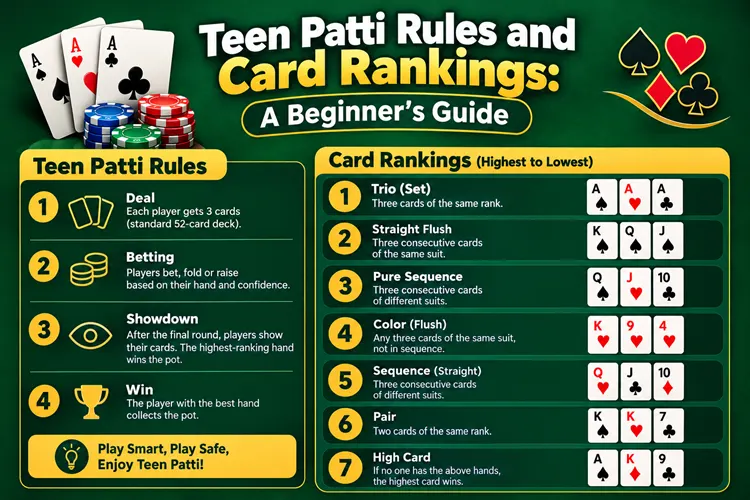
The rankings. Trail, Pure Sequence, Sequence, Color, Pair, High Card. Know them so well that you can name your hand at a glance.
The vocabulary. Boot (the starting stake), blind and seen (playing without or with looking at your cards), chaal (a bet to stay in), raise, pack (fold), show and side show.
The flow of a round. Boot, deal, betting, drop-outs, show, pot. You can explore this in more detail in our guides on how a round works.
The habits that matter most
- Play practice or low-stake tables first. Treat early sessions as lessons.
- Play seen. Blind betting looks exciting but you’re gambling without information.
- Fold weak hands. About three out of four hands are just a high card, so folding is normal.
- Set a budget and a time limit before you open the app.
How to know you’re ready to move on
You can recite the rankings without hesitation, you don’t tap the wrong button under pressure, and you’re no longer surprised by how often you fold. Your sessions end within your budget and time limit.
Stage 2: The Intermediate Player
At this level, you know the rules. The goal now is to make better decisions with the same cards.
Understand hand frequency
Out of 22,100 possible three-card hands, roughly:
- Trail: 0.24%
- Pure Sequence: 0.22%
- Sequence: 3.3%
- Color: 5.0%
- Pair: 16.9%
- High Card: 74.4%
These numbers tell you how rare a strong hand really is. When an opponent bets heavily, the odds that they hold something strong are higher than you might feel, because most people don’t bet big with high-card hands. Keep that in mind before you call a big raise with a low pair.
Learn to read behavior
Online, you can’t see faces. You can see habits:
- Speed: quick raises, long pauses, or sudden changes.
- Blind frequency: who plays blind often, and what happens when they do.
- Folding patterns: who folds to the first pressure, and who never folds.
- Escalation: how their bets change over several rounds.
Choose one or two habits to watch per session and take mental notes. A player who bluffs once isn’t automatically a bluffer. Look for repeated behavior.
Develop a bluffing rhythm
Bluff rarely and for a reason. Choose players who fold to pressure, keep your betting consistent with the story you’re telling, and avoid forcing it when you’re frustrated. If you’re already known as an aggressive player, even an honest strong hand may get called less, which can be useful too.
Use sunk costs correctly
Chips already in the pot are gone. The only question is whether the next bet makes sense on its own. This sounds simple but it’s the hardest habit for many intermediate players, because it fights against pride.
Start tracking your own play
After each session, ask:
- Did I fold enough?
- Did I bluff for a reason?
- Did I chase a loss?
- Did I stick to my budget and time limit?
Most apps keep a history of recent hands. The hands that cost you the most will show you your biggest leaks.
Stage 3: The Advanced Player
Advanced play isn’t about secret knowledge. It’s about applying the basics more consistently and with better judgment.
Think in terms of cost versus reward
Before calling a bet, compare what it costs to what you could win. If a call is cheap relative to the pot, you can stay in with a weaker hand. If it’s expensive, you need a stronger reason. This is often called pot odds, and while Teen Patti has less published mathematics than poker, the idea carries over: the price of staying in should match the chance and size of the reward.
Use blind play as a tool, not a habit
Advanced players understand blind betting as a way to manage cost and information. A blind bet is cheaper, can keep you in a round, and can send confusing signals. But it’s a deliberate choice. If you notice yourself playing blind because you’re impatient or bored, that’s not strategy.
Manage table image
Everyone at the table forms an impression of you: tight, loose, aggressive, passive. Advanced players are aware of that impression and use it. If you’ve folded for ten rounds, a sudden raise carries weight. If you’ve been raising constantly, a real strong hand may find fewer callers. The point isn’t to be unpredictable for its own sake, but to know what your actions will be read as.
Adjust to the mode
Each game mode changes what a good hand is.
- Classic: standard ranking, with strong hands rare.
- Muflis: the lowest hand wins, so flip your instincts.
- Joker and AK47: wild cards inflate hands, so a pair or even a color is worth much less.
- Best of Four: you pick the best three of four cards, so evaluate every combination.
Take time to recalibrate. A common advanced mistake is carrying classic hand values into wild-card games.
Handle shows and side shows with intent
Know exactly how your app handles show costs, side show acceptance and ties, because small details change the math. A side show can save chips but also leaks information. Opponents can usually refuse, and it’s not available against blind players.
Control emotions (tilt)
Strong players lose too. What differs is what they do next. Tilt, the state where frustration drives your decisions, costs more than any strategic error. Signs include raising out of anger, calling to prove a point, and ignoring your budget. The fix is mechanical: take a break, stand up, drink water, and end the session if needed.
Think long-term about money
Advanced bankroll management means:
- Splitting your budget into small units so a bad run doesn’t wipe you out.
- Stopping at your limit, no matter how close a comeback feels.
- Remembering that platforms may take a fee from pots, which means that over a long period, the house can collect more than players win.
- Treating spending as entertainment, not income.
If you ever catch yourself thinking of the game as a way to earn a living, that’s a signal to step back.
Common Traps at Every Level
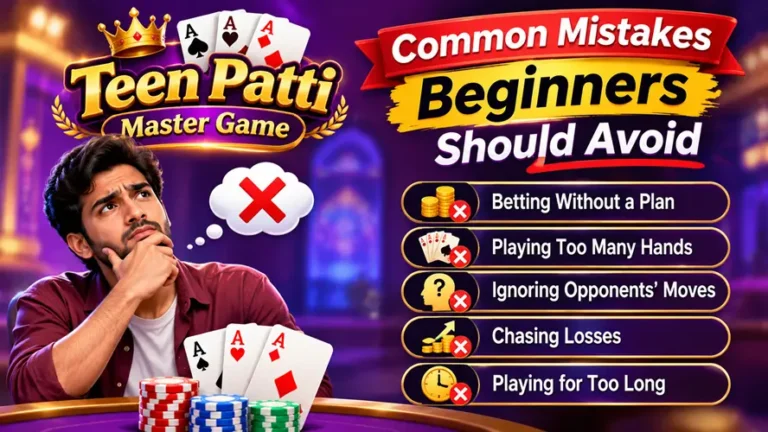
- Overconfidence after a win. A good session doesn’t mean your strategy is perfect.
- Moving up in stakes too fast. Higher tables usually have more experienced players.
- Overreading patterns. Small samples can mislead.
- Ignoring app rules. Details differ between platforms.
- Forgetting security. Download only from official sources, and never share OTPs or passwords.
Staying Healthy as You Improve
Getting better at the game can make it more engaging, and that’s a reason to keep your limits firmer, not looser. Take regular breaks, avoid playing when upset or tired, and watch for warning signs such as borrowing to play, hiding your activity, or feeling anxious when you can’t play. If those appear, take a break and talk to someone you trust. Our Responsible Gaming page has more guidance. Players must be 18 or older, and laws on online card games, especially real-money play, vary by country and state, so check your local rules.
Final Thoughts
Progress in Teen Patti is gradual. Beginners learn the rules, intermediate players learn to read, and advanced players learn to control themselves. The last part is the hardest and the most valuable. Move through the stages at your own pace, review your sessions honestly, and remember that the real goal isn’t to beat everyone, it’s to play well and enjoy it.
Frequently Asked Questions
How long does it take to go from beginner to advanced?
There’s no fixed timeline. Learning the rules takes minutes, but building judgment comes from many sessions of paying attention to your own decisions and your opponents’ habits.
Can skill really matter in a game based on random cards?
Yes. Cards are random, but betting decisions, folding discipline, reading opponents and money management are skills that improve over time. Skill reduces losses and improves decisions, but it can’t guarantee wins.
What’s the biggest difference between beginners and advanced players?
Consistency and self-control. Advanced players fold more, bluff for reasons, adapt to the mode, and stop when they reach their limits.
How do I read opponents online?
Watch speed, blind frequency, folding patterns and sudden changes in behavior. Judge patterns over several rounds rather than single hands.
Should advanced players still play blind?
Sometimes, but as a deliberate choice. Blind bets are cheaper and can manage information, but they’re a gamble because you don’t know your hand.
What is tilt?
Tilt is when frustration or emotion starts driving your decisions. Signs include angry raises and calling just to prove a point. Taking a break is the most effective cure.
Do strategies change in modes like Joker or AK47?
Yes. Wild cards make strong hands common, so hands like pairs lose value. Always recalibrate to the mode’s rules before betting.
Is it possible to make a living from Teen Patti?
It’s not something to plan on. Results swing widely, platforms may charge fees, and treating the game as income often leads to poor decisions. Think of it as entertainment.
When should I move to higher stakes?
When you’ve played steadily at your current level, stay within your limits, and feel comfortable with the pace. Never move up to chase losses.
Is online Teen Patti legal?
That depends on where you live. Laws vary, particularly for real-money play, so check your local regulations before you begin.