Teen Patti Master Online: Teen Patti Hand Rankings Explained
Every Teen Patti decision, whether to bet, raise, bluff or fold, rests on one question: how good is my hand compared to what others might be holding? You can’t answer that without knowing the rankings by heart. The good news is that there are only six types of hand, and once you understand the logic behind the order, they’re easy to remember. This guide covers each hand, how ties are settled, and the small details that often confuse beginners.
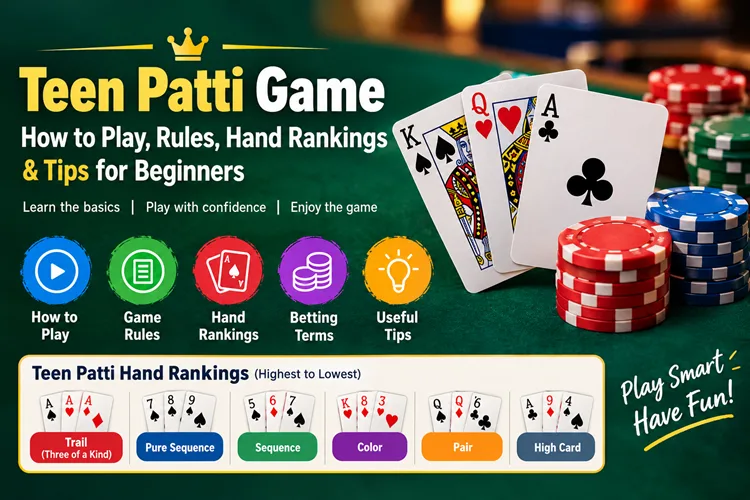
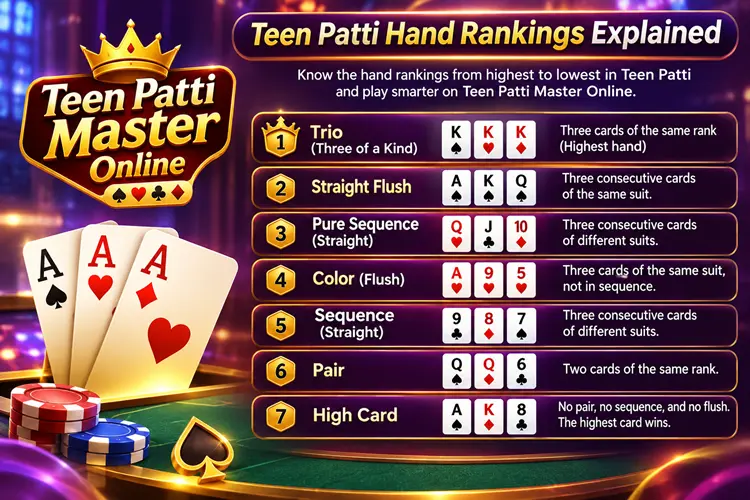
The Rankings at a Glance
From strongest to weakest:
- Trail (Set)
- Pure Sequence
- Sequence
- Color
- Pair
- High Card
Teen Patti uses a standard 52-card deck, and each player gets three cards. Card values run Ace, King, Queen, Jack, 10 down to 2, and suits have no rank of their own. Now let’s look at each hand properly.
1. Trail (Set)
Three cards of the same rank, such as three Kings or three sevens. This is the best hand in the game. Three Aces is the highest trail, three 2s the lowest, and any trail beats every other type of hand. If two players both hold trails, the higher rank wins.
2. Pure Sequence
Three consecutive cards of the same suit, for example the 5, 6 and 7 of hearts. Some players call it a straight flush. Among pure sequences, A-K-Q is the highest. In most versions A-2-3 ranks second, because the Ace is treated as a special card, and then the sequences descend from K-Q-J down to 4-3-2.
3. Sequence (Run)
Three consecutive cards in mixed suits, such as the 9 of spades, 10 of hearts and Jack of diamonds. It ranks below a pure sequence because the matching suit makes the other hand harder to get. The same internal order applies: A-K-Q at the top, A-2-3 next in most versions, and so on down.
4. Color
Three cards of the same suit that are not in sequence, for instance the 2, 8 and King of clubs. Think of it as a flush. When two colors meet, the highest card decides the winner. If those match, compare the second card, then the third.
5. Pair
Two cards of the same rank plus one unrelated card, like two Queens and a 4. A pair of Queens beats a pair of Tens. If two players hold the same pair, the third card breaks the tie. A pair is a decent hand, but not a dominant one, which is why bets from other players deserve attention.
6. High Card
When you have none of the above, your highest card decides. A hand of Ace, 9, 4 beats a hand of King, Queen, Jack. If the top cards match, the second card is compared, then the third. Most hands in the game fall into this category, so knowing when to fold a high card hand is a key skill.
Why This Order? A Look at the Odds
Many beginners are told that the rarest hand ranks highest. It’s a handy memory aid, but it isn’t perfectly true. With 22,100 possible three-card combinations in a 52-card deck, the numbers look like this:
| Hand | Combinations | Approx. chance |
|---|---|---|
| Trail | 52 | 0.24% |
| Pure Sequence | 48 | 0.22% |
| Sequence | 720 | 3.3% |
| Color | 1,096 | 5.0% |
| Pair | 3,744 | 16.9% |
| High Card | 16,440 | 74.4% |
(These figures assume Ace can play high or low in sequences but no wraparound, such as K-A-2.)
Notice that a Pure Sequence is actually slightly rarer than a Trail. Trail still ranks higher by long-standing convention. It’s one of those rules you simply learn rather than derive. After those two top hands, the order does follow rarity: sequences are rarer than colors, colors rarer than pairs, and so on. Also notice how often you’ll end up with a plain high card. Roughly three out of four hands are in this category, which is a big reason why patience and folding matter so much.
How Ties Are Broken
- Same type of hand: Compare the card ranks. A Trail of Nines beats a Trail of Sevens.
- Pairs: Compare the pair first, then the third card.
- Colors and high cards: Compare the highest card, then the second, then the third.
- Identical ranks: If everything matches in rank, many versions split the pot. Some apps use their own tie-breaking rules, such as favoring the player who didn’t request the show, so check the table details.
Suits don’t break ties in standard play.
The Ace Question
The Ace causes more arguments than any other card. In most versions, A-K-Q is the best sequence and A-2-3 is second best. Some tables rank A-2-3 as the lowest sequence, and wraparound hands like Q-K-A-2 are not valid. Online, the app’s rules decide. With friends, agree beforehand.
Rankings in Other Modes
Not every mode follows the classic order:
- Muflis: The ranking is reversed, so the lowest hand wins.
- Joker and AK47: Wild cards can complete a hand, making strong hands much more common. A pair may carry less weight than in classic play.
- Best of Four: You receive four cards and choose the best three, but the ranking itself remains the standard one.
Before joining any non-classic table, read the mode’s rules so your instincts don’t mislead you.
Tips for Memorizing the Rankings
- Learn in pairs. Remember Trail and Pure Sequence as “the top two,” then Sequence and Color as “the middle,” then Pair and High Card as “the bottom.”
- Say it out loud. Reciting the order a few times is more effective than reading it silently.
- Use practice tables. Free or low-stake tables let you see rankings in action without pressure.
- Rank your hand each round. Before betting, name your hand type. It builds speed.
Using Rankings to Make Better Decisions
Knowing the order is the start. Using it well means understanding context. A pair of Fives may be strong against a table of cautious players and weak against someone raising aggressively. A Color is often a good hand but can lose to a sequence, so don’t get carried away. And since high card hands are so common, folding them under pressure is usually wise. Rankings tell you what beats what; reading the table tells you what’s likely to be out there.
Play within your means, too. Set a budget and a time limit before you start, avoid chasing losses, and see our Responsible Gaming page if you’d like more guidance. Players must be 18 or older, and laws on online card games, especially real-money play, differ by country and state, so check your local rules.
Final Thoughts
Six hands, one order, and a few tie-break rules: that’s all there is to Teen Patti rankings. The rest is experience. Keep the list handy until it becomes second nature, and you’ll find that every other part of the game, from betting to bluffing, gets easier.
Frequently Asked Questions
What is the highest hand in Teen Patti?
A Trail, which is three cards of the same rank. Three Aces is the strongest possible hand.
Which is higher, a Trail or a Pure Sequence?
A Trail. By standard convention, it ranks above a Pure Sequence, even though the two are almost equally rare.
What is the difference between a Sequence and a Pure Sequence?
Both have three consecutive cards. In a Pure Sequence, all three cards share a suit. In a Sequence, the suits are mixed.
How does a Color differ from a Sequence?
A Color has three cards of one suit but not in order. A Sequence has consecutive cards but mixed suits. A Sequence ranks higher.
Is A-2-3 a valid sequence?
In most versions, yes. Many tables rank it as the second-highest sequence, but some rank it lowest, so check the rules.
How are two pairs compared?
The higher pair wins. If the pairs are the same rank, the third card decides.
Do suits ever break ties?
Not in standard Teen Patti. If all card ranks match, most versions split the pot, though some apps have their own rules.
How often will I get a high card hand?
Very often. Roughly three out of four hands are plain high card hands, which is why folding weak hands is such an important habit.
Do rankings change in Muflis?
Yes. In Muflis, the order is reversed and the lowest hand wins. Always read a mode’s rules before you play.