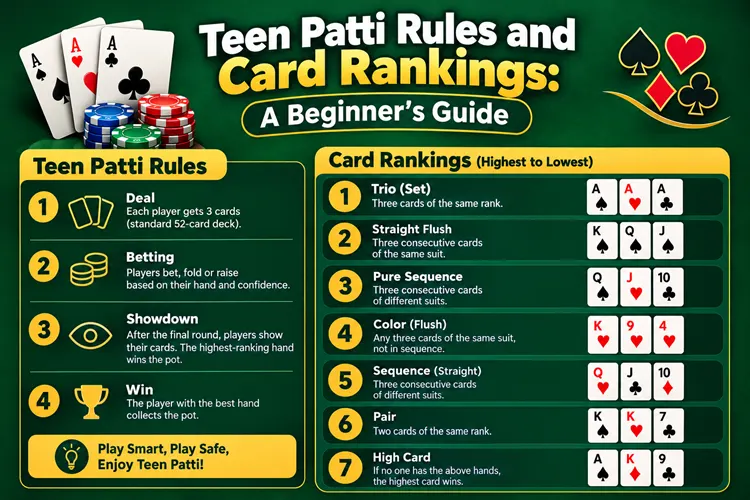

Teen Patti Master Game Rules: A Beginner’s Guide
Ask ten people to explain Teen Patti and you’ll get ten slightly different answers. One will swear that A-2-3 is the best sequence, another will insist it’s the worst, and a third will tell you the rules in their family are “different.” That’s part of the game’s charm, but it can leave beginners confused. This guide lays out the standard rules in plain language, points out where tables commonly differ, and helps you avoid the small misunderstandings that trip up new players.
The Game at a Glance
Teen Patti means “three cards.” Each player gets three cards, and the aim is to win the pot by holding the best hand at the end, or by making everyone else give up first. It’s played with a standard 52-card deck, normally without jokers, and tables usually seat three to six players. Online apps like Teen Patti Master often follow these conventions, though individual modes can add their own twists.
Rule 1: The Cards
Cards rank from high to low: Ace, King, Queen, Jack, 10, 9, 8, 7, 6, 5, 4, 3, 2. Suits don’t have a rank. Spades are not “better” than hearts. Suits only matter when forming a Color or a Pure Sequence.
The Ace is special. It can be the highest card (A-K-Q) or the lowest (A-2-3) when forming a sequence. Most tables do not allow a “wraparound” such as K-A-2.
Rule 2: The Hand Rankings
From strongest to weakest:
- Trail (Set): Three cards of equal rank, like three Kings. Three Aces beats everything.
- Pure Sequence: Three consecutive cards of the same suit.
- Sequence: Three consecutive cards of mixed suits.
- Color: Three cards of one suit, not in order.
- Pair: Two cards of the same rank and one different card.
- High Card: The best single card when nothing else applies.
The ordering follows a simple logic: the harder a hand is to get, the higher it ranks.
Rule 3: The Boot
Before cards are dealt, every player puts a fixed amount into the center. This is the boot. It creates a starting pot so every hand has something to win. Without it, there’d be little reason to play weak cards or to bluff.
Rule 4: Blind and Seen Play
Once the cards are dealt, you can look at them or not.
- Blind: You haven’t looked at your cards. You bet a lower amount, but you’re playing without information.
- Seen: You’ve looked at your hand. Your bets are typically higher, usually double the blind amount.
You can stay blind for as long as you want, and you can switch to seen at any point on your turn. Once you’ve looked, you can’t go back to blind. A common rule is that a blind player may bet either the current stake or double it, while a seen player must bet at least the current stake in seen terms. Exact limits vary by app, so check the table information before joining.
Rule 5: Betting Moves
On your turn, you can:
- Chaal (call): Match the current stake and stay in the round.
- Raise: Increase the stake, usually by up to a set multiple, to pressure opponents.
- Pack (fold): Leave the round. You lose whatever you’ve already put in the pot.
Play proceeds clockwise. You can’t skip a turn or check the way you can in some poker games. When your turn comes, you either pay to continue or fold.
Rule 6: The Show
When only two players remain, either can request a show. Both hands are revealed and compared, and the stronger one wins the pot. In many games, the player who requests the show pays the cost of doing so, and if a blind player is facing a seen player, the seen player usually has to cover the extra amount. Again, this varies, so read the app’s rules.
Rule 7: The Side Show
A side show is a private comparison available to seen players. If you’ve seen your cards and the player before you has too, you can ask them for a side show. If they accept, both of you look at each other’s cards in private. The player with the weaker hand folds. If the hands are equal, usually the player who requested the side show must fold.
A player can refuse a side show, so it’s more of a tactical request than a command. It’s never allowed against a blind player.
Rule 8: Ties and Split Pots
If two hands are the same type, the higher cards decide. A pair of Queens beats a pair of Tens. For identical sequences or colors, the highest card wins. If every card matches in rank, most versions split the pot, though some apps use special rules, such as giving the win to the player who didn’t request the show.
The A-2-3 Question
This is the most argued rule in Teen Patti. In most standard versions, A-K-Q is the highest sequence and A-2-3 is the second highest, treating the Ace as a special low card. Some house rules reverse this or rank A-2-3 as the lowest. If you’re playing online, the app’s rules decide. If you’re playing with friends, agree on it before the first deal.
Common Variations
Once you know the classic game, you’ll see variants such as:
- Muflis: The lowest hand wins.
- Joker: Certain cards act as wild cards.
- AK47: Aces, Kings, 4s and 7s are wild.
- Best of Four: You get four cards and play the best three.
Always read the mode’s description, because rankings and bets can shift.
Beginner Mistakes to Avoid
Staying in too long. Money already in the pot is gone. Don’t keep betting just to justify earlier bets.
Blind-betting too early. It looks exciting but it’s a gamble. Learn seen play first.
Ignoring the rules of the mode. A rule from classic Teen Patti may not apply in a variation.
Playing too fast. Online timers can fold your hand automatically if you hesitate. Practice at low-stake tables to get comfortable with the pace.
Playing Responsibly
Understanding the rules is only half of playing well. The other half is keeping the game healthy.
- Decide on a budget and time limit before you play.
- Never chase losses with bigger bets.
- Treat spending as entertainment, not income.
- Take breaks, and stop if the game stops being fun.
If you notice warning signs such as borrowing money to play or hiding your activity, step back and talk to someone you trust. See our Responsible Gaming page for more guidance. Players must be 18 or older, and laws on online card games, especially real-money ones, vary by country and state, so check your local rules before you play.
Final Thoughts
Teen Patti’s rules are short, but the game has depth. Learn the rankings, understand blind and seen play, know how a show and side show work, and agree on any unclear rules before the cards are dealt. With those foundations, you can focus on the fun part: reading the table, choosing your moments, and enjoying the occasional well-timed bluff.
Frequently Asked Questions
What is the first rule every Teen Patti beginner should learn?
The hand rankings. Know that a Trail beats a Pure Sequence, which beats a Sequence, then Color, Pair and High Card.
How many cards does each player get?
Three, dealt face down. Some variations, like Best of Four, deal more.
Can I look at my cards whenever I want?
Yes. You can look at any point on your turn and switch from blind to seen. You can’t go back to blind afterward.
What happens if two players have identical hands?
The higher-ranked cards decide. If everything matches, most versions split the pot, but some apps use their own tie-break rules.
Is A-2-3 a valid sequence?
In most versions, yes, with the Ace playing low. How it ranks varies between tables, so check the rules of the game you’re playing.
Can I refuse a side show?
Yes. The player being asked can decline, and a side show can’t be requested against a blind player.
What does it mean to pack?
It means to fold. You exit the round and forfeit any chips you’ve already put in.
Do the rules differ between apps?
The core rules are the same, but details like betting limits, show costs and tie-breaks can differ. Always read the table information before you play.
Is online Teen Patti legal?
It depends on where you live. Laws vary, particularly for real-money play, so check your local regulations first.