
Teen Patti Master Online Games: Complete Guide for Beginners
If you’ve ever watched a Teen Patti round at a family gathering, you know the pull of the game: three cards, a pile of chips, and a table full of people trying very hard to look relaxed. Today that same table fits in your pocket. Apps such as Teen Patti Master let you join a game in seconds, which is great for convenience but can feel overwhelming if you’re new. This guide covers everything in one place: the rules, the rankings, the betting, the game modes, and the habits that keep the game fun.
What Is Teen Patti?
Teen Patti means “three cards” in Hindi. It’s a South Asian card game closely related to three-card brag, and it has been a fixture of festivals and family evenings for generations. The goal is simple: hold the best three-card hand at the showdown, or convince everyone else to fold before it gets that far.
What keeps people hooked is that it’s easy to learn and hard to master. The rules fit in a few minutes. Knowing when to bet, bluff or walk away takes much longer.
The Basics: Cards and Players
The game uses a standard 52-card deck, usually without jokers. Tables typically seat three to six players, though online tables can vary by app and mode. Every player receives three cards face down.
Card values run from Ace down to 2. The Ace is flexible: it can be high (A-K-Q) or low (A-2-3) when forming sequences. Suits have no ranking of their own, but they matter for hands like Color and Pure Sequence.
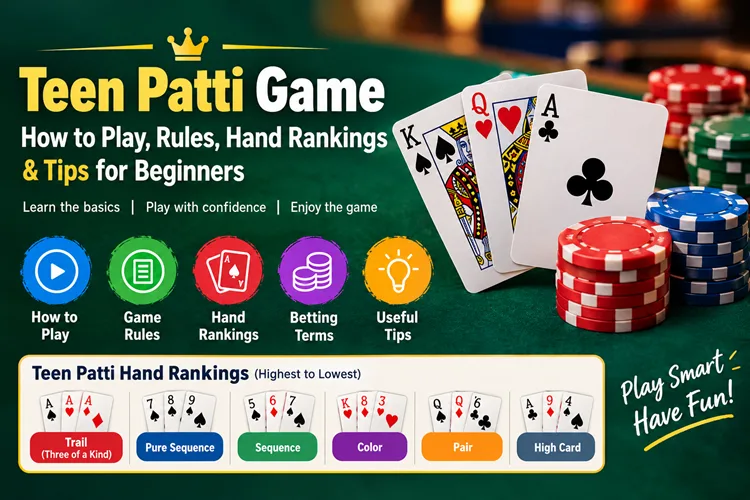
Hand Rankings, Strongest to Weakest
This is the most important thing to learn, so take your time here.
1. Trail (Set): Three cards of the same rank, such as three Queens. Three Aces is the highest.
2. Pure Sequence: Three consecutive cards of the same suit, such as the 4, 5 and 6 of spades.
3. Sequence: Three consecutive cards in mixed suits, such as the 8 of hearts, 9 of clubs and 10 of diamonds.
4. Color: Three cards of the same suit that don’t form a sequence.
5. Pair: Two cards of the same rank plus one different card.
6. High Card: When you have none of the above, your highest card decides. If those tie, the next highest is compared.
The logic is easy to remember: the rarer the hand, the higher it ranks. When two players hold the same type of hand, the higher cards win. A pair of Kings beats a pair of Sevens.
How a Round Works
The boot. Each player puts in a small mandatory amount, called the boot, to create the starting pot.
The deal. Everyone gets three face-down cards.
The betting. Play moves clockwise. On your turn you can bet to stay in, raise the stake, or pack (fold). Folding means leaving the round and forfeiting what you’ve already put in.
Blind vs. seen. You can play blind by betting without looking at your cards, which usually costs less. Once you look, you’re seen, and bets generally cost more. Blind play is cheaper but riskier, because you’re betting without knowing your hand.
The show. When two players remain, one can ask for a show, where both hands are revealed. The better hand takes the pot. Some versions also allow a side show, a private comparison between two seen players, where the weaker hand must fold.
Popular Variations
Most online apps offer more than the classic game. Common modes include:
- Muflis: the ranking is reversed, so the lowest hand wins.
- Joker: one or more cards act as wild cards and can stand in for anything.
- AK47: Aces, Kings, 4s and 7s are wild.
- Best of Four: you’re dealt four cards and build the best three-card hand.
Rules for these modes can differ slightly between apps, so always read the mode’s instructions before you join a table.
Getting Started Online
Starting out is usually quick:
- Download from an official source. Avoid links from random social media posts or chat groups.
- Create an account using your phone number or email, following the app’s verification steps.
- Explore the interface. Find the buttons for pack, chaal, show and blind or seen play.
- Try a practice or low-stake table. Most apps provide free chips or beginner tables for exactly this purpose.
- Watch a few rounds before you bet, noticing how people play.
Never share OTPs, passwords or card details with anyone, even if they claim to be support staff.
Beginner Strategy That Actually Works
Fold more than you think you should. Weak hands are not worth chasing. Folding early protects your chips and keeps you in the game longer.
Play seen at first. Once you’re comfortable with the betting levels, you can start experimenting with blind play.
Don’t bluff constantly. A bluff works because it’s rare. If you do it every round, observant players will catch on.
Forget what’s already in the pot. Money you’ve already bet is gone either way. The only question is whether the next bet makes sense.
Study your opponents. You can’t see faces online, but you can see habits: who raises quickly, who plays blind often, who folds at the first pressure. Those patterns repeat.
Move up slowly. Higher-stake tables attract more experienced players. Earn your way there with practice.
Etiquette at the Table
Even online, manners matter. Keep chat friendly, don’t taunt players who lose, and don’t pressure others to bet. If a table feels hostile or uncomfortable, simply leave and join another. A good game is one where everyone enjoys themselves.
Staying Safe and Playing Responsibly
This part is just as important as the rules.
- Set a budget before you play, an amount you could lose without it affecting your bills or savings.
- Set a time limit and use a timer. Online rounds are fast, and sessions can stretch without you noticing.
- Don’t chase losses. If you lose your budget for the day, stop.
- Avoid playing when upset, tired or distracted.
- Treat spending as the price of entertainment, never as a way to earn money.
Pay attention to warning signs such as borrowing to play, hiding your activity, or feeling anxious when you can’t play. If you notice them, take a break and talk to someone you trust. Our Responsible Gaming page has more guidance.
Laws about online card games, especially those involving real money, vary widely by country and state. Check the regulations where you live, and remember that most platforms are for adults aged 18 and above only.
A Quick Glossary
- Boot: the mandatory starting contribution to the pot
- Blind: playing without looking at your cards
- Seen: playing after viewing your cards
- Chaal: a bet to stay in the round
- Pack: fold
- Show: reveal and compare hands when two players remain
- Trail: three of a kind, the top hand
Final Thoughts
Teen Patti rewards patience over drama. Learn the rankings, understand blind and seen play, start at low stakes, and keep your budget and time firmly in your own hands. The instincts, like reading a table or sensing a bluff, come with practice. Take it one round at a time and enjoy the game for what it is: a bit of friendly tension and a lot of fun.
Frequently Asked Questions
Is Teen Patti difficult for beginners?
No. The rules are simple and can be learned in a few minutes. The strategy takes longer, but practice tables make it easy to learn as you go.
What is the best hand in Teen Patti?
A Trail, three cards of the same rank. Three Aces is the strongest possible hand.
What does playing blind mean?
It means betting without looking at your cards. Blind bets usually cost less, but you take on more risk because you don’t know what you’re holding.
Can I practice without spending money?
Yes. Most apps offer free chips or practice tables, which are ideal for learning the interface and the flow of the game.
How many players can play at one table?
Classic Teen Patti usually has three to six players, but online tables may differ depending on the app and the mode.
Is Teen Patti a game of luck or skill?
Both. Luck decides which cards you receive, while betting decisions, reading opponents and managing your budget depend on skill.
What should I do if I lose more than planned?
Stop playing for the day. Don’t raise your bets to recover losses. Take a break, and consider setting a lower limit next time.
Is online Teen Patti legal?
That depends on where you live. Rules vary by country and region, particularly for real-money play, so check your local laws before you begin.
How do I choose a safe app?
Download only from official sources, read the terms and user reviews, make sure there’s clear customer support, and never share passwords or OTPs.