Understanding Teen Patti Master Rules and Card Rankings
Few card games capture the energy of a crowded living room quite like Teen Patti Master. The shuffle, the quiet tension as players peek at their cards, the sudden raise that makes everyone lean in: it’s a game built on psychology as much as luck. Today, apps like Teen Patti Master have brought that same experience to your phone, which means more people than ever are sitting down at a virtual table without knowing the rules inside out. If that sounds like you, this guide will take you through the rules, the card rankings, and the basic betting flow so you can play with confidence from your very first hand.
The Foundation: Cards and Players
Teen Patti is played with a standard 52-card deck, without jokers in the classic version. Between three and six players usually sit at a table, and each one receives three cards dealt face down. Card values run from Ace (which can be high or low depending on the sequence) down to the 2. Suits don’t carry a ranking of their own, but they matter when you’re forming certain hands, as you’ll see below.
The aim is straightforward: finish with the strongest three-card hand, or make everyone else fold before the showdown. That second part is what makes the game so interesting. A modest hand played with a straight face can beat a better hand played nervously.
Card Rankings Explained
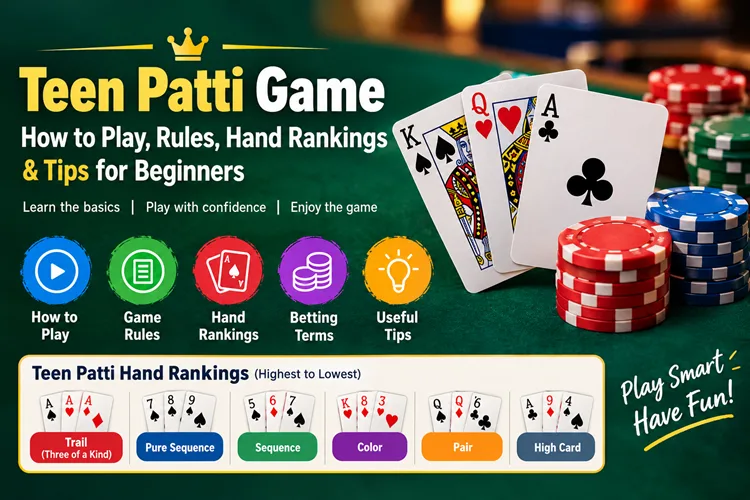
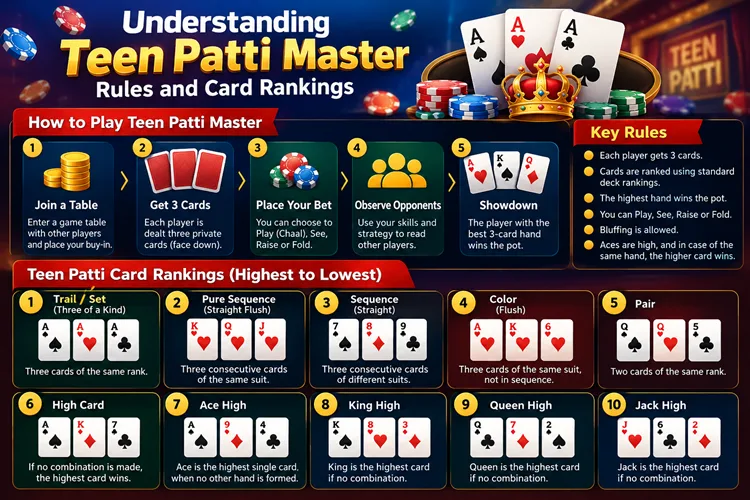
Knowing the hierarchy of hands is the single most important skill in Teen Patti. Here they are, from strongest to weakest.
Trail (Set): Three cards of identical rank, like three kings. This is the best hand in the game. Three Aces is the highest trail, while three 2s is the lowest.
Pure Sequence (Straight Flush): Three consecutive cards of the same suit, such as the 5, 6, and 7 of hearts. A-K-Q is the strongest pure sequence, and A-2-3 typically comes next in ranking, though some tables vary on this.
Sequence (Straight): Three consecutive cards of mixed suits, for example the 9 of spades, 10 of hearts, and Jack of diamonds.
Color (Flush): Three cards of the same suit that are not in sequence, like the 2, 8, and King of clubs.
Pair: Two cards of the same rank plus one unrelated card. A pair of Queens beats a pair of Tens, and if pairs match, the third card decides.
High Card: When none of the above apply, the highest card in your hand determines the winner. If two players tie on the top card, the next highest card is compared, and so on.
A quick memory trick: the rarer a hand is to get, the higher it ranks. Trails are the hardest to land, which is why they sit at the top.
How Betting Works
Every round begins with a boot amount, a small mandatory contribution from each player that creates the starting pot. After the cards are dealt, play moves clockwise.
Players can choose to play blind, meaning they bet without looking at their cards, or seen, meaning they’ve viewed their hand. A blind player bets a lower amount, usually half of what a seen player must bet, which makes blind play a clever way to keep costs low and mislead opponents. The trade-off is obvious: you’re gambling without information.
On your turn, you can match the current stake, raise it, or pack (fold) and sit out the rest of the round. Once you fold, you forfeit whatever you’ve already put into the pot.
When only two players remain, either one may request a show, where both hands are revealed and compared. If a player is blind, the rules usually require that the seen player pays for the show, which keeps things balanced. Some tables also allow a side show, where a seen player asks the previous seen player to privately compare hands. The player with the weaker hand must fold, and the rounds continue.
Popular Variations You’ll Meet
Once you’re comfortable with the classic game, you’ll notice that many apps offer different modes:
- Muflis: The ranking is reversed, so the lowest hand wins.
- Joker: One or more cards are designated as wild and can stand in for any card.
- AK47: Aces, Kings, 4s, and 7s act as wild cards, producing unusual and exciting hands.
- Best of Four: You receive four cards and form the best three-card hand.
Each variation shifts the strategy slightly, so learn the rules of a mode before jumping in. Treat your first few rounds in any new mode as practice.
Practical Tips for New Players
Start with the basics and resist the urge to experiment too soon. Spend a few sessions at low-stakes or practice tables, simply watching how experienced players bet. Notice who raises aggressively, who folds early, and who likes to play blind. Those habits tell you more than any strategy article can.
Fold weak hands without guilt. A common beginner mistake is staying in too long because of the money already committed. That money is gone either way, so the real question is whether the next bet is worth it.
Finally, play for enjoyment and set a clear budget. The game is meant to be entertaining, and keeping your spending within comfortable limits is part of playing smart. If you’re considering real-money play, check the laws that apply in your region first, since rules about online gaming differ widely.
Final Thoughts
Teen Patti rewards players who combine knowledge with composure. Memorize the rankings, understand how blind and seen betting shift the odds, and take your time reading the table. The more you play, the more instinctive it becomes, until you can sense when a raise is a bluff and when someone is holding a trail. Master these fundamentals and you’ll be ready to enjoy everything the game has to offer.
Frequently Asked Questions
What is the highest hand in Teen Patti?
A Trail, also called a Set, is the strongest hand. It consists of three cards of the same rank, and three Aces is the best possible trail.
Which is higher, a Pure Sequence or a Trail?
A Trail is higher. Although a Pure Sequence is rare, three of a kind is even harder to get, so it takes the top spot.
Is A-2-3 a valid sequence?
Yes. In most versions, A-2-3 counts as a sequence, with Ace playing low. Some apps rank it differently, so check the rules of the table you’re playing at.
What does playing blind mean?
Playing blind means you bet without looking at your cards. Blind bets are usually cheaper, but you take on more uncertainty because you don’t know your hand.
What happens if two players have the same type of hand?
The ranks of the cards break the tie. For example, a pair of Kings beats a pair of Nines. If the hands are identical in rank, the pot is typically split, though some platforms apply their own rules.
How many players can join a table?
Classic Teen Patti is usually played by three to six people, though online tables sometimes allow more depending on the app and game mode.
Is Teen Patti a game of luck or skill?
It’s a mix of both. Luck decides the cards you receive, but reading opponents, managing your bets, and choosing when to bluff or fold all depend on skill and experience.
Can beginners practice without spending money?
Yes. Most platforms offer free chips or practice tables so you can learn the rules, test strategies, and get comfortable with the interface before playing for anything of value.