Teen Patti Master: Understanding Cards, Betting & Winning Conditions
Teen Patti looks simple from the outside: three cards each, a pile of chips in the middle, and someone smiling a little too confidently. But the game rests on three ideas that work together. The cards decide what you hold, the betting decides how much pressure each player faces, and the winning conditions decide how a round actually ends. Once you understand how these three fit, the game stops feeling like guesswork. This guide takes them one at a time, with plain explanations and practical examples for online play.
Part One: Understanding the Cards
The Deck and the Deal
Teen Patti uses a standard 52-card deck, normally without jokers. Most tables seat three to six players, and each person receives three cards face down. Online, the app deals automatically, and your cards stay hidden until you choose to look.
Card Values
Cards rank from high to low: Ace, King, Queen, Jack, 10, 9, 8, 7, 6, 5, 4, 3, 2. Suits (spades, hearts, diamonds, clubs) have no rank of their own. A spade is not “better” than a heart. Suits only matter when forming a Color or a Pure Sequence.
The Ace is flexible. It can be high (A-K-Q) or low (A-2-3) when forming sequences. Wraparounds such as K-A-2 are generally not valid. How A-2-3 ranks compared to other sequences varies slightly between tables, so check your app’s rules.
The Six Hands
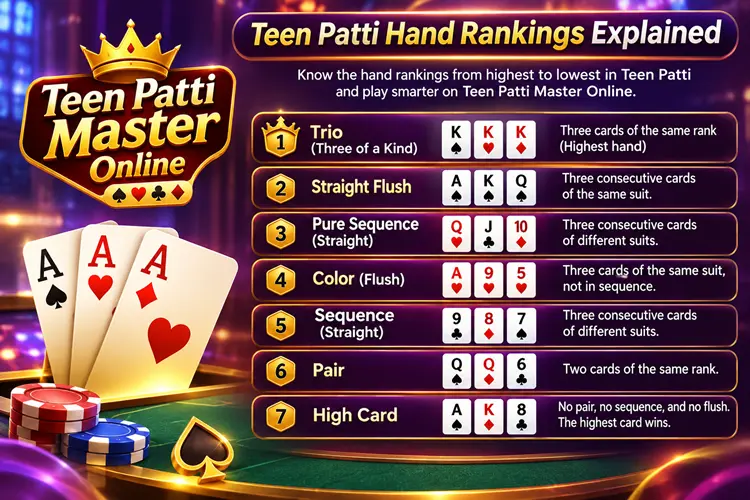
From strongest to weakest:
- Trail (Set): Three cards of the same rank, such as three Kings. Three Aces is the best hand in the game.
- Pure Sequence: Three consecutive cards of the same suit, like the 5, 6 and 7 of hearts.
- Sequence: Three consecutive cards of mixed suits, like the 9 of spades, 10 of hearts and Jack of diamonds.
- Color: Three cards of the same suit that aren’t in order.
- Pair: Two cards of the same rank plus one different card.
- High Card: None of the above. Your highest card counts.
How Common Is Each Hand?
Knowing how often hands appear helps you judge your own cards. Out of 22,100 possible three-card combinations:
| Hand | Approx. chance |
|---|---|
| Trail | 0.24% |
| Pure Sequence | 0.22% |
| Sequence | 3.3% |
| Color | 5.0% |
| Pair | 16.9% |
| High Card | 74.4% |
Two takeaways. First, about three out of four hands are just a high card, so folding is a normal part of play. Second, a Pure Sequence is actually slightly rarer than a Trail, yet Trail ranks higher by convention. It’s one of those rules you simply learn.
Part Two: Understanding Betting
The Boot
Before any cards are dealt, every player puts a small fixed amount into the middle. This is the boot. It creates a starting pot, giving everyone a reason to play and to bluff.
Blind and Seen
After the deal, you choose how to play:
- Blind: You bet without looking at your cards. Blind bets are usually cheaper, but you’re gambling without information.
- Seen: You look at your hand first. Bets are typically higher, often double the blind amount.
You can stay blind as long as you like, but once you look, you can’t go back. Exact betting limits vary by app, so read the table details.
Your Options on Each Turn
Play moves clockwise, and online turns are timed. On your turn, you can:
- Chaal: Match the current stake and stay in.
- Raise: Increase the stake to put pressure on others.
- Pack: Fold. You leave the round and forfeit what you’ve already put in.
Unlike some poker games, there’s no “check.” You either pay to continue or you fold.
How Betting Builds a Story
Every bet tells opponents something. A quick raise can signal strength, or an attempt to look strong. A long pause before a call may suggest doubt. Over several rounds, these signals form patterns. Since you can’t see faces online, reading betting behavior is your main source of information.
Show and Side Show
When only two players remain, either can request a show. Both hands are revealed and compared. The player requesting it, or sometimes the seen player facing a blind one, may have to pay extra, depending on the app.
A side show is a private comparison between two seen players. You ask the previous seen player to compare cards, and they can usually refuse. If they accept, the weaker hand folds. It’s not allowed against a blind player, and tie-handling rules vary, so check how your app handles it.
Part Three: Understanding Winning Conditions
There are only two ways to win a Teen Patti round.
Win by Everyone Else Folding
If every other player packs, you win the pot automatically, and no one needs to see your cards. This is why bluffing exists. A strong bet can win with a hand that would lose at a showdown.
Win at the Show
If two players reach the show, the better hand wins. Hands are compared in this order:
- Hand type: A Trail beats a Pure Sequence, which beats a Sequence, and so on down the list.
- Card ranks within the same type: A Trail of Nines beats a Trail of Sevens. A pair of Queens beats a pair of Tens.
- Kickers and remaining cards: For identical pairs, the third card decides. For colors and high card hands, compare the highest card, then the second, then the third.
Ties
Suits don’t break ties in standard play. If every card matches in rank, many versions split the pot, though some apps have their own rules, such as favoring the player who didn’t request the show.
Winning in Other Modes
- Muflis: The ranking is reversed, so the lowest hand wins.
- Joker and AK47: Wild cards stand in for any card, making strong hands much more common.
- Best of Four: You get four cards and play the best three, with standard ranking.
Always read a mode’s rules before joining a table, since the instincts you built in classic play might not apply.
Putting It All Together: A Sample Round
Imagine four players. Everyone pays the boot, and cards are dealt. You look and find a pair of Eights. A cautious player packs. Another raises quickly. You decide a pair is decent and call. The raiser raises again. Now you weigh your hand (a pair appears only about 17% of the time, but plenty of hands beat it), the betting (two raises suggest strength or a bluff), and the player (have they bluffed before?). You decide to pack. You lose the chips already bet, but you save the cost of continuing.
That small decision shows how cards, betting and winning conditions connect. Your hand sets the baseline, the betting shows what others might hold, and the winning conditions remind you that you don’t always need the best hand, only the right moment.
Habits That Help
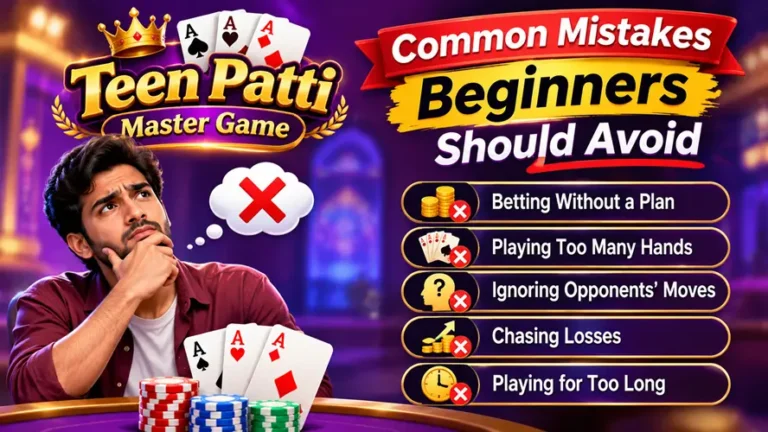
- Name your hand each round before betting.
- Fold weak hands without guilt.
- Ignore sunk costs. Chips already in the pot are gone either way.
- Bluff sparingly, since a bluff works because it’s rare.
- Watch opponents’ patterns, not single moves.
- Practice at free or low-stake tables before moving up.
Playing Responsibly
Set a budget and time limit before you play, never chase losses, and treat any spending as the cost of entertainment. If you notice warning signs like borrowing to play or hiding your activity, take a break and talk to someone you trust. See our Responsible Gaming page for more guidance. Download only from official sources, and never share OTPs or passwords. Players must be 18 or older, and laws on online card games, especially real-money play, vary by country and state, so check your local rules.
Final Thoughts
Cards tell you what you hold, betting shows what everyone is willing to risk, and winning conditions explain how it all ends. Understand those three and you’ll see each round as a series of small, sensible decisions rather than a lucky dip. Keep learning, stay patient, and enjoy the game at a pace that suits you.
Frequently Asked Questions
What is the highest hand in Teen Patti?
A Trail, three cards of the same rank. Three Aces is the strongest possible hand.
How do I win a round of Teen Patti?
Either hold the best hand at the show or make every other player fold. If everyone else packs, you win without revealing your cards.
What happens if two players have the same type of hand?
The ranks of the cards decide. A pair of Kings beats a pair of Nines, and for identical pairs the third card breaks the tie.
Do suits matter when comparing hands?
Not in standard play. Suits only matter for forming a Color or Pure Sequence. If all ranks match, most versions split the pot.
What does playing blind mean?
Betting without looking at your cards. It’s usually cheaper, but you have no information about your hand.
What does “pack” mean?
Pack means fold. You exit the round and lose the chips you’ve already put in.
What is a show?
When two players remain, one can request a show, where both hands are revealed and the stronger one wins the pot.
Can I refuse a side show?
Yes, in most versions. A side show is only available between seen players and can’t be requested against a blind player.
Do winning conditions change in Muflis?
Yes. In Muflis the ranking is reversed, so the lowest hand wins. Always read a mode’s rules before playing.
Is online Teen Patti legal?
That depends on where you live. Laws vary, especially for real-money play, so check your local regulations before you begin.